


Financing for equity in primary and secondary education
1. Education resources to subnational governments
2. Education resources to schools
3. Education resources to students and families
4. Social policies and family support programmes
Introduction
In Jordan, the Ministry of Education (MoE) centrally manages and oversees education budgets for primary and secondary education under the national budget. The MoE funds free, compulsory basic education, covering school infrastructure, maintenance, staff salaries, utilities, textbooks, school feeding, and transportation for children with disabilities. Most of the budget goes to wages and operational costs. Public revenues are pooled by the Ministry of Finance, and the MoE allocates funds to national programmes and projects. Schools do not receive direct cash transfers but get resources and services through regional directorates and projects. Some initiatives, especially for refugee support, are co-funded with international donors.
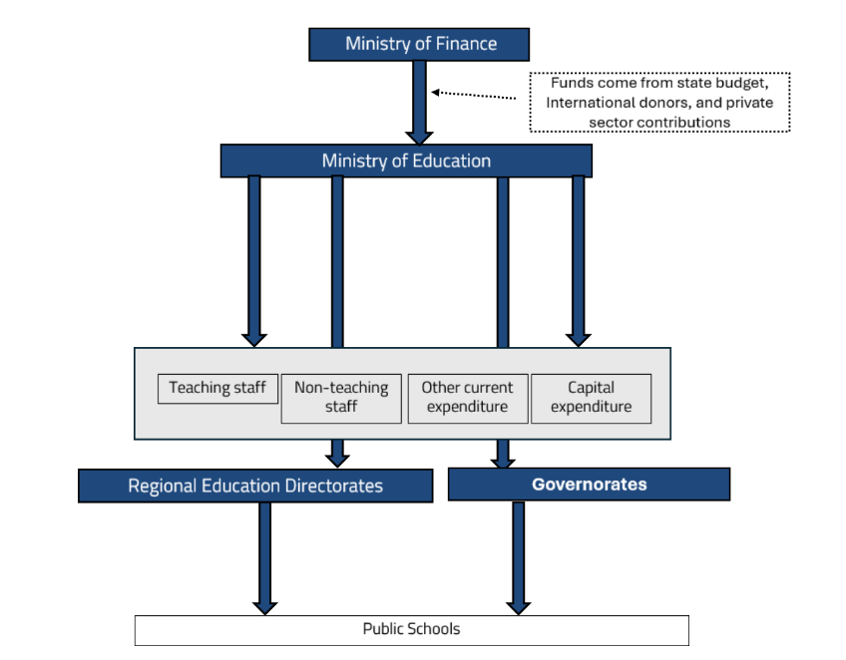
Source: PEER team
1. Education resources to subnational governments
The Ministry of Finance (MoF) is the main funding source for governorates and municipalities, operating under laws like the Decentralization Law (2015) and the Municipalities Law (2021). Funds are mainly allocated through central government transfers, including unconditional block grants based on population, poverty, and geography; conditional grants for specific projects requiring MoF or Ministry of Interior approval; and a small share of national tax revenues. While municipalities can collect local revenues such as fees and rents, they have limited autonomy and must get central approval for new taxes. Most donor funding bypasses local governments, though some aid goes directly to refugee-hosting areas. Subnational budget proposals are reviewed and adjusted by the MoF before being included in the national budget and released.
2. Education resources to schools
The Ministry of Education allocates budgets to Regional Education Directorates, which provide schools with in-kind support like textbooks, infrastructure, and teacher salaries instead of direct funding. Project-based spending, often supported by international donors, focuses on infrastructure and equipment. Schools have no financial autonomy, as decisions are made centrally or regionally.
Inclusive Education Programme
Jordan has made significant strides in special education and inclusive schooling, starting with the Nazik Al-Hariri Welfare Center in 1985, which offers specialized services for children with disabilities. Foundational laws such as the 1993 Law for the Welfare of Handicapped Persons and the 2007 Law on the Rights of Persons with Disabilitiesmandated inclusive education. These policies paved the way for the ongoing Special Education Programme, which provides integration support, assistive technologies, and vocational training, though funding remains uneven. The 10-Year Inclusive Education Strategy (2019–2029) sets enrolment goals and infrastructure improvements, while the 2025 National Framework for Inclusion seeks to standardize practices with individualized education plans and explore equity-based funding.
Launched in 2008, the Madrasati Initiative targets disadvantaged urban and rural schools, including those hosting refugees, selected based on infrastructure needs, poverty, and performance. It focuses on rehabilitating facilities like classrooms, labs, and sanitation to improve learning environments. Funded by public-private partnerships and international donors, the initiative does not follow an equity-based funding formula.
Expanded after the 2011 Syrian refugee crisis, these programmes continue to serve Syrian and Palestinian refugees in formal schools and camps. Schools in high-refugee areas and camps are prioritized to ensure access to education while easing pressure on host communities. Key features include double-shift schools, where Jordanian students attend morning shifts and Syrian refugees attend afternoon shifts, and extended class hours introduced in 2016. Funding is provided through UN partnerships, covering operational costs such as textbooks and utilities. Refugee camp teachers receive stipends from UN agencies, but government salary bonuses are not offered to educators in these schools.
3. Education resources to students and families
No information was found.
4. Social policies and family support programmes
Established in 1986 under the Ministry of Social Development through Law No. 36, the programme initially focused on unconditional cash transfers to poor families without specifically targeting education. However, reforms after 2010 gradually introduced education-related support, helping vulnerable households cover schooling costs. By 2023, the National Aid Fund (NAF) had expanded its cash transfer programme to prioritize families with children and refugees, while continuing to use income-based selection through the Unified Registry system.
The MASAR (Modernizing Education, Skills, and Administrative Reforms) Programme in Jordan, backed by World Bank financing, is implemented through the Ministry of Planning and International Cooperation alongside other government entities. It officially became effective in September 2024 and will run until June 2029. MASAR focuses on improving access to foundational learning, enhancing labor market-relevant technical and vocational education and training (TVET), and boosting the efficiency and governance of the education sector. The programme specifically targets disadvantaged youth, dropouts, and rural populations by addressing key transition points from home to school and school to work, supporting quality improvements in early childhood education, foundational skills, and public sector education management reforms. It incorporates components like teacher training and school feeding programs to improve outcomes and inclusiveness, aligning with Jordan’s broader Economic Modernization Vision and the Public Sector Modernization roadmap for 2023-2025.
5. School meal programmes
The National School Feeding Programme (NSFP), launched in 1999, operates through two main models. The Healthy Meal Model, introduced in 2022, delivers daily nutritious breakfasts to children from kindergarten to sixth grade across schools in six governorates. Meanwhile, the Biscuit Model distributes fortified date bars as a morning snack to students from pre-primary to sixth grade, targeting high-poverty areas and Syrian refugee camps.
The programme is jointly funded by the Jordanian government and international partners, with the World Food Programme (WFP) playing a central role. Implementation is overseen by the Ministry of Education in partnership with the WFP. The NSFP focuses on schools in disadvantaged regions and refugee-hosting areas, aiming to combat food insecurity and support vulnerable children.
All meals comply with national nutritional guidelines and are developed under the guidance of nutritionists and specialists to meet the dietary requirements of school-aged children. The Healthy Meal Model provides freshly prepared breakfasts, while the Biscuit Model offers fortified snacks.
This profile was reviewed by the Jordan Ministry of Planning and International Cooperation.










