


Financing for equity in primary and secondary education
1. Education resources to subnational governments
2. Education resources to schools
3. Education resources to students and families
4. Social policies and family support programmes
Introduction
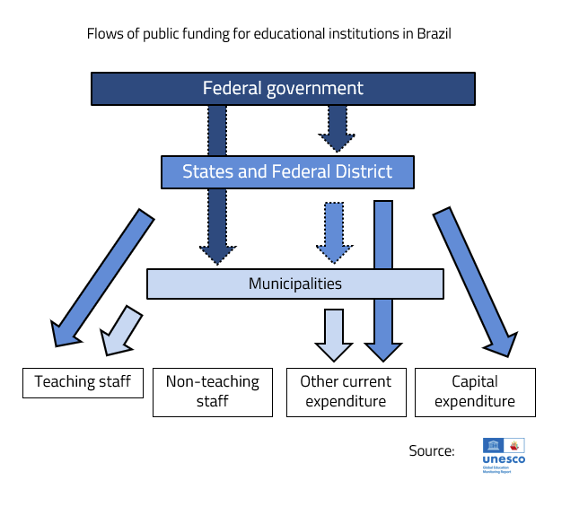
In Brazil, the Federal Union is responsible for coordinating national education policy. Its role includes providing technical and financial support to the States, the Federal District, and the Municipalities to develop their education systems. The National Fund for Education Development (FNDE), established in 1968, implements the Ministry of Education’s policies. FNDE funds a wide range of programmes across all stages and modalities of basic education in Brazil—such as school feeding, transportation, infrastructure improvements, equipment acquisition, schoolbooks, and the Direct Money at School Programme—transferring resources automatically or voluntarily to the 26 states, 5,569 municipalities, and the Federal District.
1. Education resources to subnational governments
FUNDEB (Fund for the Maintenance and Development of Basic Education and Appreciation of the Teaching Profession) is Brazil’s permanent financing mechanism for public education, covering expenses such as teachers’ salaries, training, and school transportation. It was established as a permanent policy by Law No. 14,113 on December 25, 2020. Since 2007, FUNDEB funds have been allocated to municipalities to support early childhood and early primary education, while states use their share for later primary and secondary education, following constitutional guidelines. The primary goal of FUNDEB is to reduce funding inequalities by equalising resources across education networks, helping to bridge gaps in per-student investment.
The National School Transportation Support Programme (PNATE) provides automatic financial transfers to cover transportation costs for public school students living in rural areas. Funds are transferred directly to States, the Federal District, and municipalities in ten annual installments. The Caminho da Escola Programme, established in 2007, prioritises students in rural and riverside areas by ensuring daily school access through buses, boats, and specially designed bicycles for regions with difficult school access.
2. Education resources to schools
Dinheiro Direto na Escola - Direct Money at School Programme (PDDE)
The Direct Money at School Programme (PDDE), created in 1995, provides supplementary financial assistance to public schools. According to Resolution CD/FNDE No. 3 of March 7, 2024, resource allocation is based on a fixed amount determined by the type of school (ranging from BRL 1,850 to BRL 5,550) and a per capita amount determined by the type of student (ranging from BRL 20 to BRL 100). In 2021, Resolution CD/FNDE/MEC No. 15, dated September 16, 2021, established criteria for allocating additional financial resources to municipal, state, and district public schools located in rural areas—including countryside, indigenous, and quilombola communities (PDDE Equity)—as well as to special education schools (PDDE Special Education).
School Kits (Minas Gerais State Government)
The “School Kits - 2025” Project is an initiative of the Minas Gerais State Government, promoted by the State Department of Education (SEE-MG). It allocates financial resources for the purchase and distribution of school materials to students enrolled in beneficiary State School Units within the state public education system.
3. Education resources to students and families
Pé-de-meia
Pé-de-meia, launched by the Ministry of Education in 2023, is a federal savings incentive programme aimed at promoting school retention and completion among public secondary students aged 14 to 24, to reduce social inequality. Students receive a monthly payment of BRL 200 upon proof of enrollment and attendance, which can be withdrawn anytime, plus an annual BRL 1,000 bonus withdrawable only after high school graduation. Including incentives and a BRL 200 bonus for taking the National High School Exam (Enem), the total support can reach BRL 9,200 per student. Initially available to students from households benefiting from the Family Allowance Programme (Programa Bolsa Família), the coverage expanded in 2024 to include families registered in CadÚnico and participants in Youth and Adult Education (EJA).
Support for the purchase of school kits (in the city of São Paulo)
The municipality of São Paulo provides financial support for students to purchase school kits, which includes school uniforms and supplies, with a total allocation of around BRL 680 million. Families receive this support as a credit to choose their own school supplies and uniforms, emphasising both autonomy and adequate preparation for the school year.
4. Social policies and family support programmes
Programa Bolsa Família (Family Allowance Programme)
The Family Allowance Programme was established by Provisional Measure No. 132 of October 20, 2003, and regulated by Law No. 10,836 of January 9, 2004. Introduced in 2006, the program aims to combat poverty through conditional cash transfers tied to school attendance monitoring. It is managed by the Ministry of Development, Social Assistance, Family, and Fight Against Hunger. Families with a total income below BRL 218 per person per month are eligible, provided their school-age children are enrolled in school and vaccinated. The Ministry of Education tracks and enforces the minimum attendance required for beneficiary students, as mandated by the programme.
5. School meal programmes
The National School Feeding Programme (PNAE), created in 1979, provides federal financial resources to support students at all levels of basic education across municipal, district, state, and federal networks, as well as philanthropic and community schools partnered with government entities. Its aim is to foster students’ growth, biopsychosocial development, learning, school performance, and healthy eating habits by providing education and nutritionally adequate meals during the school term. The National Fund for the Development of Education (FNDE) automatically transfers PNAE funds directly to State Education Secretariats and Municipal Prefectures in up to eight instalments between February and September, as established by Resolution CD/FNDE No. 7 of May 2, 2024. Funding per student is higher for those attending schools in indigenous areas and quilombo communities.
This profile was reviewed by Camila Maria Bortot, Professor and researcher at the Federal University of Paraná, Curitiba (UFPR).










