


Financing for equity in primary and secondary education
1. Education resources to subnational governments
2. Education resources to schools
3. Education resources to students and families
4. Social policies and family support programmes
Introduction
Bosnia and Herzegovina (BiH) consists of two entities—the Federation of Bosnia and Herzegovina and the Republika Srpska—as well as the self-governing Brčko District. The Republika Srpska has a centralised education system, while the Federation of BiH is decentralised and composed of ten cantons. In some areas, cantonal legislation further delegates education authority to municipalities.
Each administrative unit—the ten cantons, Republika Srpska, and Brčko District—maintains its own Ministry of Education, which manages the education system under its own laws, policies, and budgets. The Federal Ministry of Education and Science serves a coordinating role among the ten cantons in the Federation, while the Ministry of Civil Affairs of BiH oversees education activities at the national level.
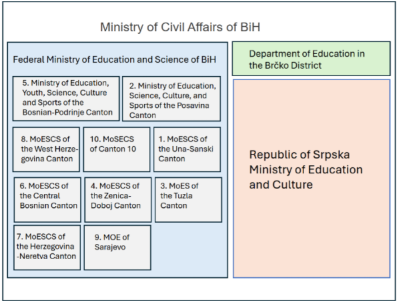
Education is funded through public resources at the entity, canton, district, and municipal levels. This results in 13 separate education budgets, not including the Ministry of Civil Affairs. Education constitutes the largest expenditure for most cantons. Although the Federation of BiH allocates funds to its ten cantons, almost no funding is distributed from the state-level budget.
1. Education resources to subnational governments
The Entity governments (the Federation of Bosnia and Herzegovina and the Republika Srpska) allocate education funds to the Cantons (within the Federation of BiH) or municipalities (within Republika Srpska), and the budgeting at this level is largely input- and norm-based. The resources allocated at the state level remain limited and are not guided by explicit equity considerations.
Within the Federation of BiH, only a limited portion of funds is distributed to the ten cantons. In 2023, the Federation allocated BAM 1,000,000 (USD 560,000) as transfers to other levels of government to support education financing. Of the total education budget, approximately 88 percent is directed towards salaries and allowances for teaching staff, 8 percent to material expenditures, and 4 percent to capital investments.
2. Education resources to schools
School Funding in Cantons and the Brčko District
|
Administrative units |
|
|
Bosnia and Herzegovina (state) |
Each administrative unit in Bosnia and Herzegovina determines how schools receive funding. It is common for schools to have their own streams of income in addition to public allocations. |
|
The Federation funds additional support programmes for schools. For example, in 2022, it distributed funds to primary schools to equip libraries to improve the quality of the learning through access to diverse and relevant reading materials. |
|
|
Schools are primarily funded by the Republika Srpska budget, with supplementary support from the local government units. The Republika covers staff salaries and training, expenses for goods and services, and student transportation. Schools are responsible for maintenance costs, while the local government unit contributes to goods and services expenses. |
|
|
The Brčko District fully funds primary and secondary public schools using the district budget. |
|
|
Public primary schools are entirely funded by the canton. The canton may also support private primary schools, contributing between 10 and 100 percent of their operating costs. Secondary schools are primarily funded by the founding entity, whether the Canton Assembly or the Municipal Council. |
|
|
Primary schools are mostly funded by the canton, which finances staff salaries, special education programmes, school meals, school maintenance, and educational materials. The local government unit funds student transportation, which the canton may subsidise if necessary. Secondary schools are funded by the canton, which may also provide additional non-conditional financial assistance to improve school conditions and meet other educational needs. The canton may additionally decide to fully or partially finance private schools. |
|
|
Primary and secondary schools are funded entirely by the founding entity, whether the Canton Assembly, Municipal Council, private owner, or religious entity. |
|
|
The canton funds public primary and secondary schools, including salaries, infrastructure, and materials to meet pedagogical standards. The canton may also co-finance private schools in the public interest and provide unconditional assistance for schools to improve educational conditions. |
|
|
The canton funds public elementary schools, covering the costs of children with special needs and transportation for students who live over 4 kilometres away. The canton may also cofinance private schools when in the public interest. Public secondary schools are funded by the founder, which is either the canton or local municipality. The founder is responsible for financing the education of students with disabilities. |
|
|
The canton fully finances public primary schools and municipalities and founders fund secondary schools. The canton may also co-finance private schools that serve the county’s interest. School founders are required to co-finance transportation costs for primary students living more than 4 kilometres from the school. |
|
|
Primary schools are jointly financed by the canton and municipalities. The canton allocated funds based on needs to meet pedagogical standards (e.g for salaries, support for gifted and students with disabilities, textbooks, and equipment). Municipalities fund transportation, nutrition, and maintenance. The canton provides extra support as needed where municipalities cannot meet funding needs as well as for the transportation of refugees and displaced students. The canton fully finances public secondary schools with special attention to the costs of vocational education and gifted students. The canton may also cofinance special programmes in private secondary schools that serve the interest of the canton. |
|
|
Primary schools are primarily financed through the canton budget and the local self-government unit. The canton budget covers staff salaries, allowances, training, special education programmes, and programmes for language minorities, while the local self-government unit provides funding for school maintenance and student transportation. |
|
|
The canton finances public primary and secondary schools and may also co-finance private schools. Additionally, the canton may fund extended-day programmes and schools in other parts of the country when in the canton’s interest. Together with local municipalities, the canton co-finances public transportation which is provided free to all students. By law, 3.5% of revenues in the canton budget must be designated to capital investment in and maintenance of public schools. |
|
|
Primary schools are co-financed by canton and local municipalities. The canton funds salaries, hot meals, transportation for staff, and costs of education for gifted students and minority language students. The municipality funds material costs and co-finances transportation for students with disabilities and those who live over 4 kilometres away from school. The canton fully funds public secondary schools and may co-finance private schools in the public interest. |
Republika Srpska
According to the 2022 Primary Education Law of the Republika Srpska, schools are primarily funded by the Republika Srpska budget, with supplementary support from the local government unit. The government covers staff salaries and training, expenses for goods and services, and student transportation. Schools themselves are responsible for maintenance costs, while the local government unit contributes to goods and services expenses.
Library Development Initiative in Primary Schools
In 2022, the Federation of BiH distributed funds to primary schools to equip libraries. The initiative was designed to improve the quality of the learning environment by ensuring pupils have greater access to diverse and relevant reading materials.
3. Education resources to students and families
Scholarships
Many cantons, in their legislation, have described a need for scholarships for full-time secondary school students. For example, the Tuzla Canton provides scholarships of BAM 1,000 to primary and secondary school students who are especially gifted, and to students with disabilities. They also target full-time high school students of Roma or other national minority descent. For the 2024/25 school year, the canton announced 64 scholarships of BAM 1,000 for full-time high school students of Roma or other national minority descent.
The Republika Srpska provides scholarships for exceptionally gifted pupils and students. The students receive monthly payments of BAM 13,000-15,000. In 2024, these scholarships were provided to more than 12,800 high school students. BAM 2.1 billion is budgeted yearly for students, though this number includes scholarships for tertiary education.
The Herzegovina-Neretva Canton provides scholarships to gifted and talented secondary students and may provide part of tuition fees for students according to family need.
4. Social policies and family support programmes
Child Allowances
The Federation of Bosnia and Herzegovina and Republika Srpska both provide family and child allowances in the form of cash transfers. These programmes are managed at the cantonal level with mixed sources of financing (entity, canton, municipal) and differing parameters. The Federation of BiH’s 2022 Law on Material Support to Families with Children provides monthly allowances to poor families and families of children with disabilities. Families qualify if the total monthly income per member is 40% or less of the lowest wage in the Federation. The child allowance provided is equivalent to 19% of the lowest salary in the Federation. While the federal level has established a baseline for care, cantons can redefine eligibility criteria or expand on the policies. As such, the income eligibility criteria for child allowances vary widely in each canton.
According to the Sarajevo Canton’s 2014 Law on Social Protection, Protection of Civilian Victims of War and Protection of Families with Children, qualifying families have the right to child allowance during their studies. Families may qualify if one of the parents or the child has a disability, if the family has three or more children, or if one of the parents is a beneficiary of permanent financial assistance. Every year, families must submit evidence of meeting the conditions for receiving the child allowance during full-time study.
The Zenica-Doboj Canton’s 2024 Law on Social Protection, Protection of Civilian Victims of War and Protection of Families with Children assists families of children with disabilities while they are in regular education. Funds are provided by the cantonal budget. Each family receives 7% of the average salary in the Canton.
5. School meal programmes
Each administrative region determines whether it provides school meals and for whom.
The Federation of BiH subsidises accommodation and meals for students who come from less developed cantons (Posavina, Bosnia-Podrinje, Canton 10) and Republika Srpska. Funds are allocated based on official data obtained by student centres, including the names and numbers of students. Programmes follow national nutritional guidelines.
This profile has been reviewed by Prof. Dr Hatidža Jahić, University of Sarajevo.










