


Financing for equity in primary and secondary education
1. Education resources to subnational governments
2. Education resources to schools
3. Education resources to students and families
4. Social policies and family support programmes
Introduction
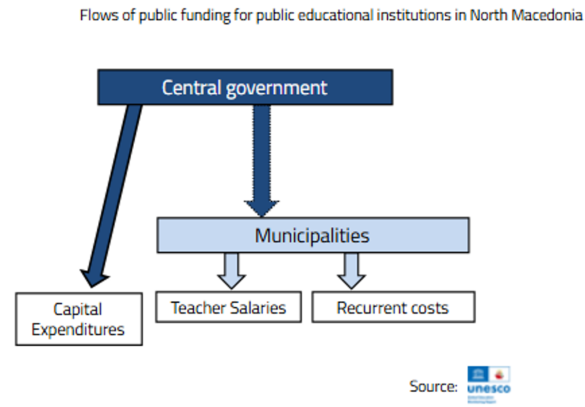
In North Macedonia, funding for basic education is governed by section XIII of the Law on Primary Education (2019, amended in 2025) and section XI of the Law on Secondary Education (1995, amended in 2025). The national budget provides these funds, which are allocated to municipalities through block and special grants. Municipalities then distribute the funds to primary and secondary schools in their area. They may also add resources from their own budgets, except for staff salaries.
The Ministry of Funding and the Ministry of Education and Science prepares the country’s annual financial plan and sets the standards and criteria for funding state primary schools. The council of municipalities does the same for municipal schools.
In 2020, the central government supplied 97% of education funding, with local governments contributing 3%. Local authorities manage 89% of spending at the municipal level. The central government covers capital expenditure, while local governments are responsible for recurrent costs, including staff salaries.
1. Education resources to subnational governments
According to the 2004 Law on Financing Units of Local Self-Government, a block grant finances competences in a specific area defined by law, while a dedicated grant supports a particular activity.
The central government allocates funds to municipalities through block grants and dedicated (special) grants that are made using a formula which is primarily based on the number of primary and secondary students in the areas with other additional indicators. Other factors can include students’ ages, school type and location, minority enrolment, and enrolment of students with disabilities. Block grants cover both teacher salaries and non-salary recurrent costs such as utilities and teaching materials.
Starting January 2026, education financing is based on a standardized per-student allocation of 112,747 denars in primary and 103,589 denars in secondary education, adjusted by a school development coefficient (0.75–2.55) and supplemented by variable components for transport, special educational needs, minority-language instruction and regional schools. Disadvantage is therefore addressed mainly through school-level development gaps and structural cost factors, rather than through direct measures of student socioeconomic background.
2. Education resources to schools
Financing Formula
From 2026, schools will receive block grants based on a new financing formula. Primary and secondary levels will receive funds under different formulas. For primary levels, the first, or basic, component is calculated according to the cost per student, which is MKD 112,747 (USD 2.1k) in 2026. This component takes into the account the degree of development of the schools by using a coefficient of 0.75-2.55. The second, variable component provides funding for student transportation and additional support for students with special educational needs, students from socially disadvantaged families, and those attending language classes in small ethnic communities (Turkish, Bosnian, and Serbian). For secondary schools, the cost per pupil is set at MKD 103,589 (USD 2k) in 2026. The variable component depends on students with special educational needs and those who follow instruction in Turkish and Serbian.
Additional funds are also provided through block and special grants for students with disabilities, calculated according to the number of such students in each school.
3. Education resources to students and families
The Ministry of Education and Science provides scholarships to students from socially vulnerable groups, including Roma high school students and students with disabilities. There were at least 13 different types of stipend programmes for students in secondary schools, several of which are merit based. The following are the programmes which had equity in mind.
Scholarships to Roma students
The "REGULAR CLASS: Action for Inclusion of Roma in Primary Education" project, supported by the EU, provides scholarships of EUR 400 per year to Roma students enrolled in the first and second grades of primary school. The programme has been publicly documented since the 2012/2013 academic year.
For Roma secondary students the Ministry awards scholarships for public and private secondary schools. In 2025/26, the ministry awarded 1200 scholarships on a merit-based criteria. Those with better grades receive more money per month.
Be IN, be INClusive, be INcluded
The "Be IN, be INClusive, be INcluded" project, initiated by the Ministry of Education and Science, provided scholarships for children with special needs enrolled in regular education. This EU-funded initiative operated from October 2019 to October 2022.
In 2025/26, the MOES distributed 180 scholarships for students with special needs of MKD 3500 per month.
Social Support Scholarship
In the 2025/26 academic year, MOES distributed 900 scholarships focused on providing social support to students from public secondary schools. The criteria for awarding the scholarship looked at the financial situation of the student’s immediate family and their social position. Results were also merit based, as the students must have had very good academic performance.
MOES also provides 50 scholarships to students without parents.
4. Social policies and family support programmes
There are four social financial assistance programmes aimed at supporting students in vulnerable situations, according to the Social Protection Law and the Child Protection Law.
Guaranteed Minimum Assistance
Families are eligible for guaranteed minimum assistance if their household income is below the level set by the government. The basic amount in 2025 was MKD 4,000, with additional amounts for each household member and MKD 800 for each child. Families must submit a certificate confirming their children’s regular studies during the application process. These amounts are adjusted yearly in line with the increase in cost of living for the previous year.
Child Allowance
Families with children may receive a child allowance if they meet low-income criteria. For school-aged children attending school in 2025, the allowance is MKD 1,000 per month for one child and MKD 1,600 per month for two or more children. These amounts are adjusted yearly in line with the increase in cost of living for the previous year.
Special Allowance
Children with special needs are eligible for a special allowance of MKD 4,202 in 2025. The amount is higher for single-parent households or for families already receiving guaranteed minimum assistance. These amounts are adjusted yearly in line with the increase in cost of living for the previous year.
Education Allowance
Education allowance supports households with children who regularly attend primary or secondary school, as verified by the Ministry of Education and Science. Students must attend at least 85% of classes. As of 2025, primary school students receive MKD 8,400 per year, while secondary school students receive MKD 12,000 per year. Payments are made in four equal instalments. These amounts are adjusted yearly in line with the increase in cost of living for the previous year.
5. School meal programmes
School Meal and Snack Programme
Since 2005, students have been provided with hot meals through the School Meal and Snack programme. While most parents pay for these meals, they are free for students from socially vulnerable groups. The central government does not directly finance the programme but allocates resources to support it, while local governments are primarily responsible for its implementation.
The Rulebook for Standards for Nutrition and Primary School Meals guides the quality and type of food provided. Subsidised meals for undergraduate students are funded by the Ministry of Education at a rate of MKD 140 per day as of 2025. These amounts may be adjusted yearly in line with the increase in cost of living for the previous year.
The PEER team expresses its gratitude to Dr Jan Herczynski (University of Warsaw) and Professor Katerina Shapkova Kocevska (SS. Cyril and Methodius University) for their support in the development of the profile.










