


Financing for equity in primary and secondary education
1. Education resources to subnational governments
2. Education resources to schools
3. Education resources to students and families
4. Social policies and family support programmes
Introduction
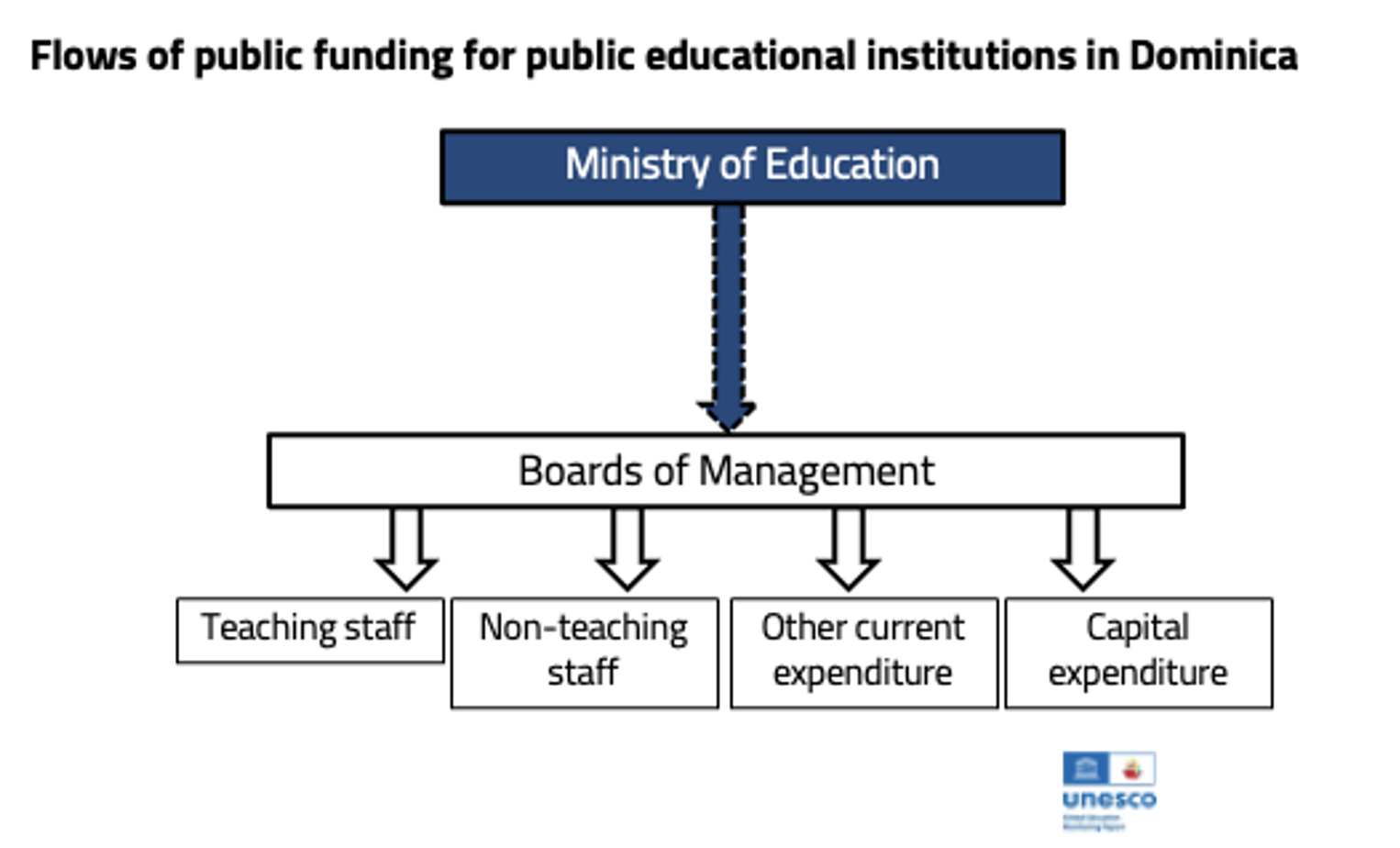
In Dominica, education financing is centralised under the Ministry of Education, Human Resource Planning, Vocational Training, and National Excellence. The Ministry oversees and directly funds public schools, which make up the majority at all levels. Private schools are managed by religious or independent organisations, while assisted schools are privately owned but receive government support, particularly for teacher salaries and infrastructure.
The Ministry is responsible for approving and defining school budgets. Discussions are ongoing regarding delegating budget management to each school’s Board of Management, which would then be responsible for spending allocated funds and submitting estimates for the following fiscal year.
1. Education resources to subnational governments
Resources are directly allocated from the central level to schools.
2. Education resources to schools
At the school level, each Board of Management oversees the use of grants for repairs, maintenance, rebuilding, and other ministerial matters, ensuring proper upkeep and sanitation of school buildings. At the end of the school year, the Board submits a statement detailing how the grant was spent, along with estimated expenditures for the next financial year, for the Minister’s approval.
3. Education resources to students and families
The Education Trust Fund was established by Parliament under Act No. 17 of 1981, known as the Education Trust Fund Act, to provide financial assistance to students from families facing serious financial difficulties. It primarily supports secondary students who cannot continue their education without this aid. The fund is financed through an annual government subvention and seeks to raise additional resources via donations from individuals, clubs, local, regional, or international associations, and fundraising activities.
The fund covers transportation costs for children from communities without government-funded bus services, registration fees for certain schools, and fees for the Caribbean Examinations Council (CXC) examinations.
4. Social policies and family support programmes
No programme offering resources to students and their families has been found.
5. School meal programmes
School Feeding Programme
The School Feeding Programme, administered by the Ministry of Education, was established in 1991 in collaboration with the World Food Programme. It provides primary school students with daily nutritious meals to support their educational development and is inclusive of all students, regardless of economic status. The programme offers in-school meals, in-school snacks, and take-home rations, with the latter specifically targeted at single-parent households and economically disadvantaged individuals. Meals are prepared according to nutritionist guidelines to meet specific nutritional goals, and the programme includes a food and nutrition education component.
This profile was reviewed by Dr Zephrine Royer, educator.










