
Financing for equity in primary and secondary education
1. Education resources to subnational governments
2. Education resources to schools
3. Education resources to students and families
4. Social policies and family support programmes
Introduction
In Panama, the General Law of Education mandates that the state is responsible for covering the costs of teaching, administrative, and service personnel, as well as providing adequately equipped facilities, textbooks, supplies, and teaching materials for primary education, and to the extent feasible, for secondary education. The budget is determined based on the previous biennium’s cost per student and projected school enrolment for the upcoming biennium.
Established in 2003 under the Executive Decree No. 238, the Equity and Quality Education Fund (FECE) functions as a financial instrument to enhance equity by allocating resources to first-level (general basic) and second-level (secondary) educational institutions.
Panama is organised into school regions, which serve as political-administrative divisions. Each region has a Regional Directorate of Education, a decentralised unit of the Ministry with full functional and administrative autonomy, tasked with implementing both regional and national educational policies.
1. Education resources to subnational governments
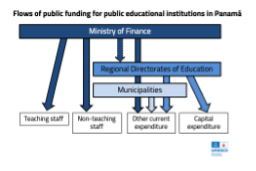
The Regional Directors of Education serve as the educational authority and represent the Minister of Education within their respective school regions. They are responsible for coordination functions and oversee substantive operational units to ensure effective implementation of educational initiatives. However, no formal equitable distribution mechanism has been identified for the transfers they receive.
Regional directorates primarily receive funds to implement School Food, Nutrition, and Health Programmes, construct and maintain school infrastructure, provide necessary equipment, implement educational policies, and train teachers and staff. The hiring of personnel remains a centralised function, with directorates limited to proposing staffing needs.
Under the General Law of Education, each municipality must allocate 20% of its annual income to first-level education and 5% to Physical Education at the first and second levels across all institutions. These allocations are approved through the municipal budget process.
2. Education resources to schools
The Equity and Quality Education Fund (FECE) represents 27% of educational insurance funds, with 94% allocated to the first two educational levels, including the Panamanian Institute of Special Habilitation. Two per cent is dedicated to administration and supervision, and 4% to teacher training. Seventy-five per cent of FECE funding supports infrastructure rehabilitation, maintenance, and acquisition of technological equipment, while the remaining 25% is directed towards student welfare, including food, transportation, health, and extracurricular activities. The fund aims to provide essential financial resources to official educational centres in the most vulnerable areas, ensuring minimum conditions for equitable and quality education. The General Allocation Plan can be adjusted to reflect changes in school populations, educational types, and tax revenue, allowing resources to respond to evolving needs.
Instituto Panameño de Habilitación Especial (Panamanian Institute of Special Qualification)
The Instituto Panameño de Habilitación Especial (IPHE) was established by Law 53 in 1951 and amended by Law 23 in 1990. The institute provides services and support for special education, ensuring access, participation, and graduation for children and youth with disabilities, while enhancing learning outcomes and functional skills. IPHE aims to strengthen prevention, habilitation, education, and job training for children and youth with disabilities nationwide, with an emphasis on community engagement and adherence to constitutional principles. Its objectives include preventing disabilities, providing early intervention for at-risk children, and offering comprehensive habilitation for school-aged children. The institute promotes the inclusion of students with disabilities in mainstream education and ensures access to available services. It also focuses on training and integrating adolescents into the labour market, expanding early detection programmes, and fostering equitable educational opportunities for all students with disabilities.
3. Education resources to students and families
Asistencia Social Educativa Universal (PASE-U) (Universal Educational Social Assistance)
The Asistencia Social Educativa Universal (PASE-U) programme is implemented by the Instituto para la Formación y Aprovechamiento de Recursos Humanos in collaboration with the Ministry of Education, and was fully launched on 1 June 2022. The programme aims to prevent absenteeism, reduce grade repetition, counter school dropout, and increase enrolment and attendance across elementary, middle, high school, and special education students, promoting educational continuity and improving academic performance. The benefit is provided to students who regularly attend the first or second level of education in both regular and special education systems. Students must maintain good attendance and conduct, with exceptions for those with special educational needs. Guardians or legal representatives are required to participate in school activities, provide health information including vaccination records, and support their child’s learning to ensure proper use of the benefit. The allowance is annual, disbursed in three payments, and varies according to the student’s level of education. Double allowances are granted to students achieving Distinguished Posts, General Competition, outstanding performance in sports, fine arts, academic or cultural events, and students receiving Disability Assistance. The first payment is allocated for school supplies and uniforms and must be issued at least fifteen days before the school year begins. PASE-U benefits continue until the completion of high school, with no restrictions on the number of beneficiaries per family. Students may also receive additional financial support from state or private institutions.
4. Social policies and family support programmes
Asistencia Económica Educativa (Financial Educational Assistance)
The Asistencia Económica Educativa programme, financed through national budget contributions, provides non-refundable financial assistance to minors, adolescents, young people, and professionals in any year of general basic, middle, and higher education who require support to pay for their studies. Individual assistance is aimed at children, adolescents, young people, and professionals beginning or completing studies in official or private educational centres that meet programme requirements, including students with disabilities in general education, high school, and undergraduate studies, with eligibility determined through socioeconomic evaluation and participation in relevant educational programmes. Other targeted support includes Economic Assistance for the Poorest Townships and Indigenous Areas, which prioritises impoverished residents in challenging family situations and students maintaining a minimum academic average of 3.0, as well as Economic Assistance for the Eradication of Child Labour. Collective assistance includes the Collective Educational Economic Assistance for Indigenous Communities, which funds projects by school groups; the Collective Educational Economic Assistance for Districts of Extreme Poverty in rural and urban areas, which finances school group projects; and the Collective Educational Economic Assistance for the Comprehensive Formation of Vulnerable Minors and Adolescents, aimed at funding educational programmes for at-risk youth organised by IFARHU’s Student Centers and NGOs.
Red de Oportunidades
The Ministry of Social Welfare (MIDES), in collaboration with MEDUCA, created the Opportunities Network (RdO), launched in 2006, which aims to expand the social protection system to historically unprotected households in extreme poverty and reduce this poverty in the short and long term. The programme provides conditional cash transfers for children's attendance at health checkups and enrollment in the education system.
5. School meal programmes
Estudiar Sin Hambre (Study Without Hunger)
The Study Without Hunger Programme, created in 2019 and implemented by the Ministry of Education in coordination with the National Secretariat for the Food and Nutritional Security Plan, aims to provide students with healthy, nationally produced food as part of the Complementary Food Programme, delivering daily snacks to vulnerable students from preschool through high school to enhance nutrition and improve school performance. Since September 2024, the programme has expanded to offer a full meal, either breakfast or lunch, to selected schools in county, rural, and urban areas, with all participating schools provided with the necessary culinary utensils and dining halls verified by infrastructure and maintenance departments to ensure proper operation. Meals consist of a balanced diet including vegetables, fruits, starches, grains, cereals, and proteins, adapted to local culture and prepared under the supervision of nutritionists and dieticians to meet students’ nutritional requirements, with the objective of extending full meal provision to all schools by 2029.