
Financing for equity in primary and secondary education
1. Education resources to subnational governments
2. Education resources to schools
3. Education resources to students and families
4. Social policies and family support programmes
Introduction
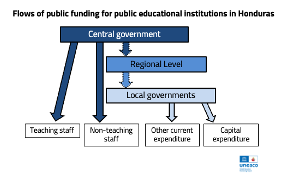
In Honduras, funding for education is organised at both central and local levels. At the central level, the government allocates resources according to each school’s fixed and operational costs. The Ministry of Education oversees planning, regulation, resource administration, supervision, and transparency across the education system, ensuring the effective implementation of national policies for pre-basic, basic, and secondary education. At the local level, funding is distributed based on the per-student unit cost, with priority given to areas experiencing the highest levels of educational exclusion. Local allocations focus on improving infrastructure, learning materials, and technology, while also supporting compensatory social programmes to address inequities. The Ministry prepares its budget based on the needs expressed by educational centres, ensuring that funds are directed to achieve measurable improvements in education outcomes.
The allocation of national public funds to education is governed by the 2011 Fundamental Law of Education, which establishes principles of rationality and equity among educational levels.
1. Education resources to subnational governments
At the departmental level, Departmental Education Directorates are responsible for administering human and financial resources within their jurisdiction. The opening and expansion of educational centres, as well as the creation of teaching positions, remain the exclusive responsibility of the Secretariat of State in the Office of Education, exercised through the Departmental Directorates.
At the district and municipal levels, District and Municipal Education Directorates act as technical pedagogical advisory units, supporting schools in achieving educational goals and quality learning under the authority of the Departmental Directorates. They operate with assigned budgets to carry out their functions. Municipal Councils for Educational Development (COMDEs) represent the lowest participatory level, coordinating strategic plans to enhance educational outcomes. COMDEs report their achievements and the list of educational centres adhering to the academic calendar to the Secretariat of State in the Office of Education, informing the distribution of central government incentives. These incentives include funding for educational centres, scholarships and bonuses for students, economic recognition and training opportunities for teachers, and support for school infrastructure and resources. Honourary recognition is also awarded to outstanding teachers, students, parents, mayors, and educational centres.
An early example of decentralised education funding is the PROHECO (Programa Hondureño de Educación Comunitaria) initiative, launched in 1999 with support from the World Bank and the government. PROHECO established rural primary and pre-primary schools managed at the community level, expanding access in underserved areas. Resources were transferred directly to communities, improving equity by targeting rural, remote, and marginalised populations traditionally underserved by public education. While PROHECO schools employed lower-paid, less formally trained teachers, they often delivered more schooling days and achieved higher attendance than conventional schools, illustrating trade-offs in equity-focused resource allocation.
2. Education resources to schools
The Honduran Community Education Programme (PROHECO)
The Honduran Community Education Programme, PROHECO, was established in 1999 by the Government through the Secretariat of Education as an alternative programme to improve the quality of preschool and lower basic education (grades 1–6) in targeted rural areas. The programme also seeks to enhance intercultural and bilingual education in indigenous communities, with over 4,000 rural schools included in the 2000s, 15% of which are in intercultural and bilingual areas. Most of these schools are multigrade.
PROHECO pursues four main objectives: developing educational strategies and materials suited for multigrade rural schools in line with the national curriculum, including any necessary intercultural and bilingual adaptations; attracting and retaining teachers in rural schools through community support and professional development incentives; strengthening and expanding community- and school-based management of rural schools; and ensuring quality support from local education offices, including school districts and departmental offices, to implement these objectives effectively.
Recurrent costs for PROHECO teaching staff were initially financed through a World Bank credit on a declining basis, enabling the government to progressively assume responsibility. Projects under this initiative also included small-scale replacements or rehabilitations of district offices of the Secretariat of Education.
3. Education resources to students and families
Becas Sociales (Social Scholarships)
Social Scholarships are awarded to students in elementary and middle school attending Official Educational Centres who achieve an academic index of 71% or higher in the current year and come from limited economic means. A specific category, known as Purple Scholarships, is reserved for female students who have experienced trauma or abuse.
4. Social policies and family support programmes
Bono Vida Mejor (Better Living Bonus)
The Bono Vida Mejor (Better Living Bonus), which operated between 2010 and 2021, aimed to break the inter-generational cycle of poverty by providing opportunities, capacity building, and skills development in education, health, and nutrition for families living in extreme poverty. The programme focused on villages and neighbourhoods with high concentrations of poverty and used a proxy means test from the Single Socioeconomic Form (FSU) of the Single Registry of Participants (RUP) to determine eligible households. Only households in areas with sufficient education and health services were included. The education component provided monthly vouchers delivered quarterly to heads of households with children aged 6–18 enrolled in the public school system.
My Beca para Escalar (My Climbing Scholarship)
In 2022, the Bono Vida Mejor programme was replaced by My Beca para Escalar (My Climbing Scholarship) under the Cash Transfer Programme managed by the Solidarity Action Programme (PROASOL), a decentralized entity of the Secretariat of State in the Office of Social Development (SEDESOL) with technical, administrative, and financial autonomy. The scholarship targets students in vulnerable circumstances, including migrants, individuals living in poverty, people with disabilities, those displaced by natural disasters, victims of substance abuse, minority groups, and members of the LGBTIQ+ community. To be eligible, students must maintain an overall academic average of 75% or higher throughout the school year.
Students are classified into three categories: Category A for Basic Level, first to sixth grade; Category B for Basic Level, seventh to ninth grade; and Category C for Middle Level, tenth to twelfth grade. Scholarships are disbursed through two annual transfers, with the number of awards determined by the Scholarship Commission of PROASOL.
5. School meal programmes
The National School Feeding Programme (PNAE) launched in 2016 by the Secretary of State in the Office of Development and Social Inclusion in coordination with the Secretary of State in the Office of Education, is one of Honduras’ largest social initiatives. It provides daily nutritionally balanced meals to students while supporting local economies through the purchase of vegetables, fruits, dairy, eggs, and other products from small producers, ensuring fresh food for school rations.
The 2016 School Food Law guarantees the right to adequate school meals for all children enrolled in public pre-basic, basic, and gradually secondary education, as well as in special education. PNAE is primarily funded by the Government of Honduras, with additional support from international organisations and NGOs, such as the World Food Programme (WFP) and Catholic Relief Services (CRS). Municipalities further strengthen the programme by allocating extra resources, creating dedicated budget lines, and upgrading kitchens, canteens, warehouses, and sanitation facilities to ensure a healthy environment for students.
While there is no specific national guideline for school meal composition, Honduras introduced Food-Based Dietary Guidelines (GABA) in 2013 as an educational tool to promote healthy, varied, and culturally appropriate diets.