


Financing for equity in primary and secondary education
1. Education resources to subnational governments
2. Education resources to schools
3. Education resources to students and families
4. Social policies and family support programmes
Introduction
In Yemen, the primary responsibility for financing education lies with the Ministry of Finance (MoF) and the Ministry of Education (MoE) at the central government level. The MoF allocates the national education budget through the annual budget law, while the MoE is tasked with planning, overseeing the implementation of education policy, and coordinating the distribution of funds across education levels. Additional actors include the Ministry of Planning and International Cooperation (MoPIC), which coordinates donor financing.
Government funding mainly covers teacher salaries, basic school operations, and limited spending on infrastructure, textbooks, and supplies. However, payments have been irregular in recent years. As a result, much non-salary spending—including textbooks, learning materials, infrastructure, and emergency education—relies heavily on donorssuch as UNICEF, UNESCO, Save the Children, and the World Bank.
The main financing mechanism is centralised, with the Ministry of Finance allocating education funds annually to the Ministry of Education through the national budget. The Ministry of Education then distributes funds to governorates and districts based on historical budgets, available revenues, and negotiated needs. Schools receive operational budgets through district offices but often rely on community contributions, school fees, or external aid for running costs. Development projects and emergency support are typically funded and managed separately by international organizations through pooled or project-based funding.
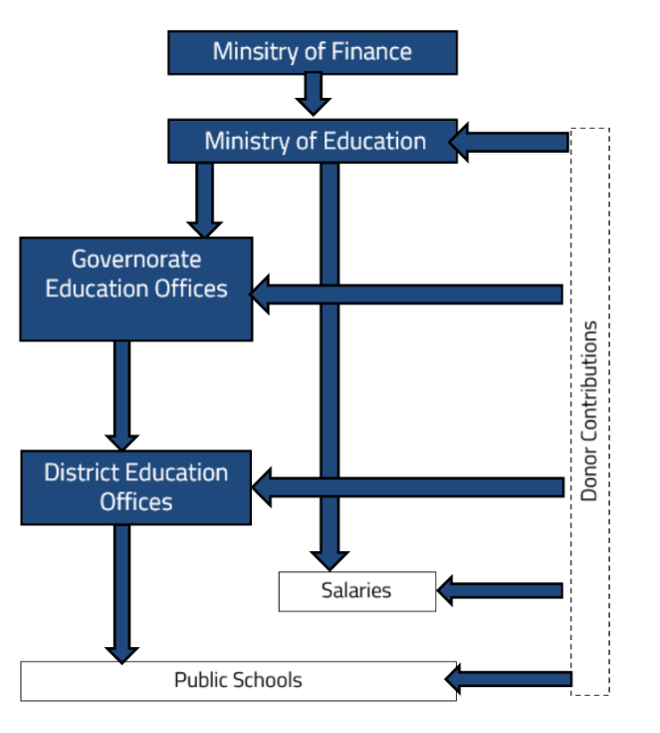
Source : PEER Team
1. Education resources to subnational governments
The allocation of education resources to governorates and districts is centrally managed by the Ministries of Finance and Education, with funds mainly based on historical budgets rather than actual needs. While a decentralised framework exists, local offices have limited authority and may depend on irregular central transfers and donor-funded programmes. There is no formal equity-based funding formula considering factors like poverty, geography, or conflict. Instead, the most equity-focused support comes from international donors like UNICEF and the World Bank, who prioritize emergency needs in underserved or conflict-affected areas. However, these efforts remain fragmented, temporary, and separate from the national system.
2. Education resources to schools
In principle, schools receive resources through centralised allocations from the Ministry of Education, which provides limited operational funds to district education offices that then distribute them to individual schools.
The National Strategy for Girls’ Education
Launched in the late 1990s under Yemen’s first Five-Year Education Development Plan (1996–2000), this strategy aimed to expand basic education access and reduce gender disparities, especially in rural areas. It targeted girls aged 6 to 15, focusing on out-of-school girls, dropouts, marginalised groups like the Muhamasheen, and poor households. Grounded in Yemen’s constitutional equality commitments and international frameworks like Education for All, its main goal was to increase girls’ enrollment and completion rates in basic education. The strategy set phased goals to boost girls’ net enrollment by 2010, reduce dropout rates, improve retention through grade 9, and enhance education quality and relevance. Key actions included building separate classrooms or schools for girls, recruiting more female teachers, providing non-formal education and literacy programs, developing gender-sensitive curricula, and promoting community engagement through awareness campaigns and local education committees. Operationally, it involved creating safe school infrastructure, offering in-kind support (like free supplies or meals), and flexible education options where formal schooling was inaccessible.
As part of Yemen’s Strategic Vision 2025, the National Strategy for Girls’ Education continues to aim for a 95% enrollment rate by 2025 through compulsory education policies, awareness raising, expanding girls’ schools, and improving retention.
3. Education resources to students and families
The National Strategy for Girls’ Education (see section 2) was the Ministry of Education’s main initiative to support disadvantaged students through in-kind aid rather than direct cash transfers. It provided free school supplies, uniforms, and, in some donor-supported cases, food assistance to reduce financial and social barriers for girls aged 6–15—especially those in rural areas, out-of-school girls, and marginalized groups like the Muhamasheen.
4. Social policies and family support programmes
All previous and current programmes found are donor-led and donor-funded.
5. School meal programmes
The government does not have a current school meal programme in place.
This profile was reviewed by Dr. Ahmed Alduais, Norwegian University of Science and Technology.










