
Financing for equity in primary and secondary education
1. Education resources to subnational governments
2. Education resources to schools
3. Education resources to students and families
4. Social policies and family support programmes
Introduction
In Syria, the Ministry of Education (MoE) holds primary responsibility for managing and allocating the education budget, particularly for basic education. The Ministry of Finance annually allocates public funds to the MoE, which then distributes resources to governorate-level Education Directorates—administrative branches of the central government. These directorates oversee the implementation of MoE policies at the local level and allocate funds to schools based on fixed criteria such as school size, staffing, and operational needs, without using per-student or equity-based formulas. While the Ministry of Local Administration nominally coordinates service delivery at decentralised levels, its role in education remains limited, with most authority and funding remaining centralised through the MoE and its local directorates.
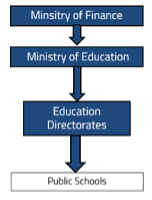
Source : PEER team
1. Education resources to subnational government
Education funding in Syria is highly centralised. The Ministry of Finance allocates the national budget to the Ministry of Education, which distributes it to governorate-level education directorates based on factors like student numbers, schools, and staff. These directorates act as arms of the central government and have little financial autonomy. Some conflict-affected or underserved areas receive extra support from international donors, but this aid is generally outside the official budget and not part of a systematic, equity-based model.
2. Education resources to schools
School funding in Syria remains centralised and based on inputs, with the Ministry of Education (MoE) directing funds through governorate-level education directorates. These directorates allocate resources to schools based on factors like student numbers, staff size, and infrastructure needs. Schools do not receive lump-sum budgets or have discretion over spending. Instead, they get in-kind support (such as textbooks, furniture, and supplies) and funding mainly for salaries and fixed costs. There is no school-based budgeting or per-student funding formula in place.
3. Education resources to students and families
No information was found regarding government programmes which support students and their families. However, external organizations may provide support. UNHCR has provided education cash grants to refugee students.
4. Social policies and family support programmes
No information was found.
5. School meal programmes
The government does not currently have a national school meal programme in place, however, since 2017, the World Food Programme (WFP) has been implementing a school meals programme for Syrian children attending public primary schools in Aleppo city, in coordination with the Ministry of Education, the Ministry of Foreign Affairs and Expatriates, the Ministry of Social Affairs and Labor, the Ministry of Health, and the Supreme Relief Committee.
The meals are targeted geographically towards grades 1-6 for in-school snacks and grade 1-8 for take-home rations. Meals are provided 5 times a week. The WFP also provides vouchers for families to buy food and hygiene items.