


Financing for equity in primary and secondary education
1. Education resources to subnational governments
2. Education resources to schools
3. Education resources to students and families
4. Social policies and family support programmes
Introduction
In Saudi Arabia, education funding is centrally managed by the Ministry of Finance (MoF) and the Ministry of Education (MoE). The MoF is responsible for allocating the national budget, including education, while the MoE oversees policy, curriculum, infrastructure, staffing, and operations across all public education levels. Unlike decentralised systems, there is no fiscal authority granted to regional or local governments; regional education officesoperate under the direct supervision of the MoE and do not have independent financial control.
The primary financing mechanism is an annual line-item budget: the MoE submits its budget proposal to the MoF, which reviews and allocates funds as part of the national budget. Once approved, funds are disbursed directly to the MoE, which then allocates resources internally to regional directorates and schools based on operational needs, school size, and programme priorities.
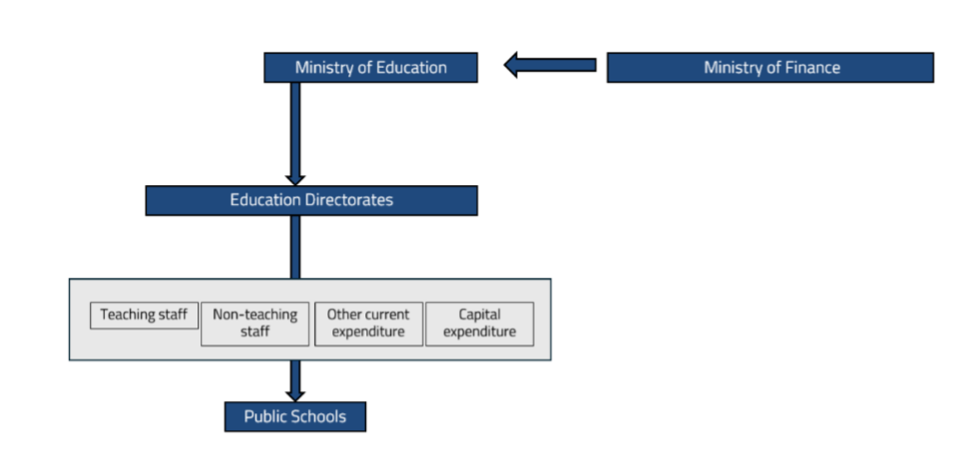
Source : PEER team
1. Education resources to subnational governments
Education funding is centrally allocated by the Ministry of Finance to the Ministry of Education, with limited local budget authority.
2. Education resources to schools
The Ministry of Education allocates funds to schools through regional directorates based on size, needs, and priorities, not per-student formulas. Schools do not manage budgets; all decisions are centrally overseen.
Special Needs Education is managed and fully funded by the Ministry of Education (MoE), guided by national strategies like the Education Strategy 2016–2020 and the National Transformation Programme 2020. The MoE is responsible for ensuring children with disabilities across all regions have access to appropriate education, aiming to integrate them into mainstream schools wherever possible. Equity efforts focus on inclusive education in “least restrictive environments,” with individualized plans and support services provided by institutions such as Prince Sultan Centers, Maaeen Special Education Project, and regional Special Education Cities. Although there is no formal equity-based funding formula, the MoE allocates resources internally based on school size, student population, and special education needs. Additional funding supports infrastructure adaptations, specialised materials, and professional support, managed through central administrative decisions without a transparent, mandated equity framework.
3. Education resources to students and families
Free Textbook Distribution Programme
The Ministry of Education (MoE) leads and fully funds the national textbook distribution programme, ensuring all public-school students receive required learning materials on time each academic year at no cost to families. The MoE manages the entire process—from design and approval to printing and delivery—coordinating logistics with regional education directorates. Schools receive shipments based on a fixed national timeline, and distribution follows strict guidelines for efficiency, safety, and health protocols. This universal programme benefits all students across regions, genders, and socioeconomic backgrounds, with particular importance for those in remote or disadvantaged areas who might otherwise face financial or logistical challenges accessing textbooks. The Ministry of Education was established in 1953 and has since overseen free education and provision of learning materials as a core function.
4. Social policies and family support programmes
The School Bag Support Programme is a social initiative managed by the Ministry of Human Resources and Social Development that provides financial aid for school supplies to disadvantaged students registered under the Social Protection Programme. Targeting students enrolled in general education, under 18, and registered in the Noor Systembefore each semester, the programme automatically disburses support once per semester directly to beneficiaries’ accounts. Coordinated with the Noor System, it ensures timely, continuous assistance aligned with the academic calendar without requiring manual applications.
5. School meal programmes
Saudi Arabia currently does not have a full school meal programme; instead, the Ministry of Education launched a targeted pilot in 2025, providing only single-item snacks—milk and dates—not qualifying as complete meals like breakfast or lunch. The Ministry is the primary financer and implementer, aiming to offer nutritious snacks aligned with healthy eating goals, though there is no formal mention of national nutritional guidelines or specialist oversight.










