


Financing for equity in primary and secondary education
1. Education resources to subnational governments
2. Education resources to schools
3. Education resources to students and families
4. Social policies and family support programmes
Introduction
In Qatar, public education funding is fully centralised and managed by national authorities. The government funds education primarily through the State General annual budget. The Ministry of Finance (MoF) allocates these funds to public and higher education institutions, while the Ministry of Education and Higher Education (MoEHE) oversees policy, planning, implementation, and fair distribution of resources to public schools. The MoEHE also sets regulations, manages budgets, and monitors school operations to meet students’ needs. It fully finances public basic education, covering both capital expenses—such as buildings, infrastructure, equipment, and transportation—and operational costs, including salaries, training, supplies, utilities, curriculum development, technology, student support, inclusive education, and services in remote areas, ensuring schools run efficiently and effectively.
To ensure fairness and accountability, the MoEHE prepares a sectoral budget based on priorities aligned with the National Development Strategy and submits it to the MoF, which has final authority over funding decisions. After legal approval, the MoF manages all financial transactions and controls auditing, while the MoEHE distributes funds and resources directly to public schools and educational programs across all levels.
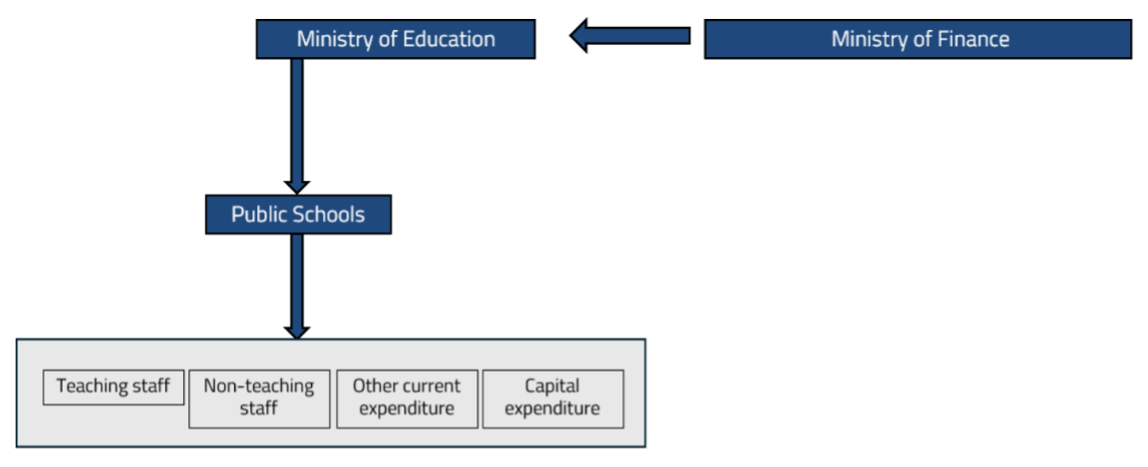
Source : PEER Team
1. Education resources to subnational governments
Governance, financing, budgeting, and resource allocation for education are fully centralised and directly managed by the Ministry of Education and Higher Education (MoEHE).
2. Education resources to schools
Special Needs Education Schools
The education system adopts a multi-tiered approach to support students with disabilities, focusing on inclusion from preschool through secondary education. Public schools provide support services, accommodations, and inclusive environments for students with various needs, including motor, hearing, and visual impairments, as well as learning difficulties. Both inclusive public schools and specialised institutions offer tailored programmes, skills training, and assistive technologies to ensure equal learning opportunities. Comprehensive assessments inform student placement and support, emphasising Individualised Education Plans (IEPs) and adapted curricula to promote meaningful inclusion in mainstream settings whenever possible. However, there is no available information on specific equity mechanisms used to allocate resources fairly to these schools.
3. Education resources to students and families
Vouchers for Students with Disabilities
Qatar has expanded its educational voucher programme to support Qatari students with disabilities attending or seeking enrollment in private schools. Launched as part of the Ministry of Education’s inclusive education strategy, the initiative aims to reduce financial barriers and promote integration by providing direct financial support through vouchers. These vouchers are categorised into three levels based on the intensity of services needed, determined by comprehensive assessments at the Ministry’s evaluation centre. The voucher amounts range from QAR 43,000 to 78,000 (approximately $11,800 to $21,400 USD). The programme targets students with multiple disabilities, including hearing, physical, motor, and visual impairments, intellectual disabilities, related syndromes, and autism spectrum disorder. Parents apply via the Ministry’s online portal “Maaref,” where they schedule assessments and track applications, with responses provided within three working days. Families then choose from accredited private schools that offer the required specialized services. This programme, backed by Cabinet Decision No. 25 (December 2023), aligns with Qatar National Vision 2030 and expands financial resources to ensure inclusive, learner-centered education tailored to students’ needs.
4. Social policies and family support programmes
No government-led initiatives were found.
5. School meal programmes
Qatar does not have a nationwide school meal programme but offers limited, targeted initiatives mainly in government schools and health-promotion pilots. Public schools, which run for 5.5 to 6 hours starting around 7:00 a.m., include a breakfast break during which students can purchase nutritious meals at low cost from school canteens. These canteens are supervised by the Ministry of Education and Higher Education (MoEHE) and follow strict nutritional standards, regulated menus, and centralized procurement to ensure quality and consistency.
This profile was reviewed by Dr. Huda Salem Al-Kubaisi, Director of the National Centre for Educational Development at the College of Education and Assistant Professor of Finance Education at Qatar University.










