
Financing for equity in primary and secondary education
1. Education resources to subnational governments
2. Education resources to schools
3. Education resources to students and families
4. Social policies and family support programmes
Introduction
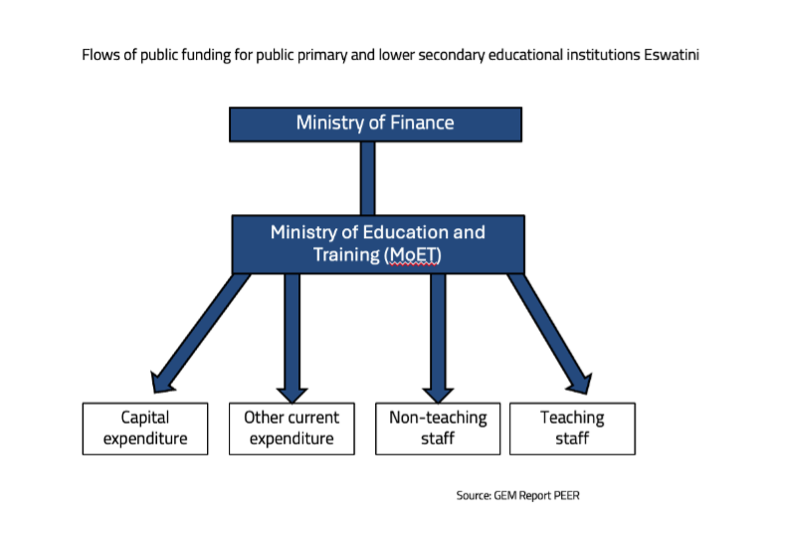
In Eswatini, the financing of education is primarily managed by the Ministry of Education and Training (MoET), which oversees budget planning, execution, and supervision of public education expenditure. MoET holds the authority for managing finances across all levels of general education and supervises the distribution of funds to schools and regional offices.
While Regional Education Offices (REOs) play a strategic role in implementing decentralisation policies and are responsible for monitoring administrative, educational, and legal activities in schools within their jurisdiction, their involvement in resource allocation is limited due to the centralised funding mechanism. They primarily manage administrative coordination and oversee the execution of centrally determined budgets and do not have significant autonomy over budget decisions.
The government finances a broad range of items within the education sector. The Teacher Service Commission (TSC), under the ministry, is responsible for teacher salaries, which account for the largest share of the budget. The ministry also oversees school operational costs, textbooks and learning materials, and infrastructure maintenance; however, the importance of balancing personnel costs with investment in these areas is increasingly being recognised. Under the Free Primary Education (FPE) policy launched in 2010, public primary education is tuition-free for Grades 1 to 7, with the state covering per-pupil grants, learning materials, and school administration costs. Education beyond the primary level remains fee-based.
1. Education resources to subnational governments
In Eswatini, Regional Education Offices (REOs) operate as administrative extensions of the Ministry of Education and Training (MoET) and do not manage independent budgets. Their role in education financing is minimal because funding decisions remain highly centralised within MoET.
REOs are supported through centrally provided operational resources, including training, data systems, and capacity-building initiatives funded by MoET and development partners. This also covers government budget allocations for the construction and rehabilitation of regional offices in the four regions, indicating that REO operations are sustained through national funding rather than locally generated revenue.
However, there is no evidence of a funding mechanism where MoET transfers resources to subnational governments based on an equity-oriented formula.
2. Education resources to schools
Free Primary Education and Per-Pupil Grants
Grounded in constitutional provisions, the Free Primary Education (FPE) policy guarantees every Swazi child access to tuition-free education. Introduced gradually from Grades 1 and 2 and fully extended to Grade 7 by 2015, the policy provides schools with per-pupil capitation grants, such as E580 for Grades 1 to 3, to cover operational costs including textbooks, school maintenance, and staff expenses. Through this mechanism, the Ministry of Education and Training ensures equitable access to quality primary education while supporting schools’ administrative and instructional needs.
3. Education resources to students and families
As of 2025, there is no publicly available evidence of any MoET programme directly supporting disadvantaged students in Eswatini.
4. Social policies and family support programmes
Grants programme for Orphans and Vulnerable Children (OVC)
Launched in 2003 as a bursary scheme, the Grants Programme for Orphans and Vulnerable Children (OVC) is administered by the Deputy Prime Minister’s Office through the Department of Social Welfare (DPMO-DSW). The programme provides financial support to disadvantaged children attending around 260 secondary and high schools in Eswatini, with each beneficiary receiving approximately E1,950 per year. These funds are transferred to schools to cover tuition fees and national examination costs, removing key barriers to progression and completion at the secondary level. As part of the government’s broader social protection framework, the OVC grant ensures that children from poor or orphaned households are not excluded from education due to poverty or loss of parental support.
5. School meal programmes
National School Feeding Programme (NSFP)
Established in 1962 with support from the World Food Programme, Eswatini’s National School Feeding Programme (NSFP) provides daily meals to children in public schools. Initially limited in scope, the programme was formalised under the 2018 Education and Training Sector Policy, which mandates school feeding for all learners in primary and secondary schools. Primarily financed and managed by the Government of Eswatini, with partner support, the programme has operated since 2020 in two modalities: school meals for in-person learners and take-home rations in vulnerable areas. Covering all public primary and secondary schools, the NSFP ensures comprehensive access to meals, while subnational nutrition inspectors monitor implementation through periodic school visits, despite the absence of national nutrition standards.