


Financing for equity in primary and secondary education
1. Education resources to subnational governments
2. Education resources to schools
3. Education resources to students and families
4. Social policies and family support programmes
Introduction
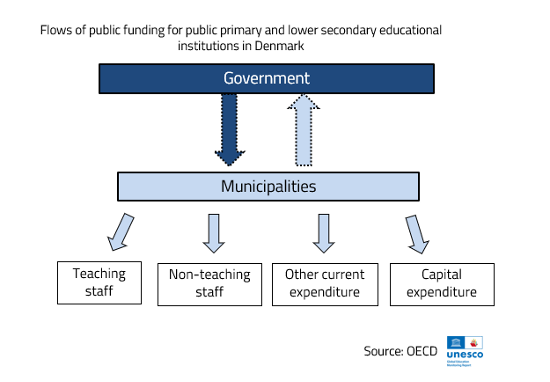
Denmark’s education system is decentralised, with the Ministry of Children and Education setting curriculum frameworks for primary and secondary levels and overseeing municipal primary and lower secondary schools (Folkeskole) together with municipal councils. Municipalities finance Folkeskole schools, while the state finances upper secondary schools (Gymnasium). Government grants cover about 80% of the total funding for self-governing educational institutions. Subnational governments derive over a third of their revenue from local taxes, mainly personal income tax. This accounts for over a quarter of total general government revenues. Municipalities are the only subnational entities with tax authority, and part of their tax collections is redistributed through an equalisation between high-income and low-income municipalities. In practice, this statutory mechanism (revised in 2007) aims to reduce disparities in fiscal capacity linked to differences in tax base, demographic structure and social conditions, by calculating each municipality’s “structural deficit” (the gap between average-rate tax revenues and estimated spending needs) and redistributing it through a national component (58 % of the gap), a capital-region component (27 %), with the remaining share allocated by population.
1. Education resources to subnational governments
In Denmark, municipalities are responsible for organizing and financing primary and lower secondary education, drawing on their own revenues supplemented by state block grants distributed through the Finance Act and adjusted by an inter-municipal equalisation system that compensates for differences in income, demographic composition, and socioeconomic conditions. This arrangement enables municipalities with weaker fiscal capacity or higher shares of disadvantaged pupils—such as those from low-income or immigrant backgrounds—to maintain comparable service levels, while the state also provides targeted subsidies for inclusion, vocational training, and other priority initiatives; upper secondary institutions, by contrast, are financed directly by the state through the taximeter system, a per-student grant set annually in the Finance Act.
2. Education resources to schools
The government funds both municipal and independent schools. Primary schools receive funding from municipalities, which combine block grants and earmarked state support. Municipalities retain a degree of discretion in how they allocate resources to local services, typically allocating funds based on student enrolment, while they must comply only with legislative content requirements, not funding levels. For instance, Aarhus Municipalitydetermines school funding partly based on the number of dual language learners and the general socioeconomic characteristics of its student population. However, there is no comprehensive source aggregating such allocation criteria across all municipalities.
Additional resources may be provided to schools in disadvantaged areas, including a “Social taximeter” that supports schools with over 30% of students at risk of dropping out (based on 9th-grade GPA). Upper secondary schools are funded by state taximeter subsidies, paid per student, alongside special individual subsidies. Denmark’s taximeter system is a results oriented public funding mechanism in which education institutions receive perstudent block grants calculated mainly on the number of enrolled students who complete courses or pass examinations, with rates that vary by level and field of study and are set annually in the Finance Act. Within the state’s overall education budget framework, activity dependent appropriations are thus automatically channelled to institutions according to objective activity targets and politically determined taximeter rates, supporting demand driven provision, efficiency and predictable budgets. The taximeter grants, supplemented by basic (fixed) grants for core costs, give institutions financial autonomy in how they use funds, while ensuring that changes in student numbers are directly reflected in their public funding. Taximeter funding was introduced for vocational education in 1991 and then gradually extended and refined across education sectors during the 1990s.oriented public funding mechanism in which education institutions receive perstudent block grants calculated mainly on the number of enrolled students who complete courses or pass examinations, with rates that vary by level and field of study and are set annually in the Finance Act. Within the state’s overall education budget framework, activitydependent appropriations are thus automatically driven provision, efficiency and predictable budgets. The taximeter grants, supplemented by basic (fixed) grants for core costs, give institutions financial autonomy in how they use funds, while ensuring that changes in student numbers are directly reflected in their public funding.‑oriented public funding mechanism in which education institutions receive per‑student block grants calculated mainly on the number of enrolled students who complete courses or pass examinations, with rates that vary by level and field of study and are set annually in the Finance Act. Within the state’s overall education budget framework, activity‑dependent appropriations are thus automatically ‑driven provision, efficiency and predictable budgets. The taximeter grants, supplemented by basic (fixed) grants for core costs, give institutions financial autonomy in how they use funds, while ensuring that changes in student numbers are directly reflected in their public funding.
The taximeter system is supplemented by activity-independent basic grants and targeted funds to address institutional vulnerabilities and specific policy goals beyond pure activity-based allocation. Basic grants—either fixed unit amounts or activity-linked support—redistribute resources toward smaller or rural institutions, compensating for their higher per-unit costs and ensuring equitable regional access to education. Additional mechanisms include time-limited earmarked grants for special purposes like innovation or inclusion, as well as repayable loans for institutions in acute financial distress, conditional on restructuring and Ministry oversight, thereby balancing efficiency with flexibility in the state's education funding framework.
3. Education resources to students and families
Every child of compulsory school age has a constitutional right to be provided with free education. Therefore, all primary education in the Folkeskole is free of charge.
On top of that, some Danish municipalities provide school transportation services(Skolekørsel) to students. This service constitutes a legal right within the Folkeskole system and applies to pupils attending their designated public school whose distance to school exceeds statutory limits or whose route is deemed traffic hazardous. Transport is typically provided free of charge through public buses, dedicated school buses, or, in the case of students with disabilities, tailored transport arrangements.
Students aged 16 to 19 also qualify for a youth card (Ungdomskort) that offers discounted transit if their daily commute exceeds 2.5 km.
4. Social policies and family support programmes
Child and Youth Allowance (Boerne-ungeydelse)
The Child and Youth Allowance is paid to parents for each child until age 18, with the amount based on the child’s age and parents’ income. Additional benefits may apply for single parents, students, or twins. Municipalities can stop payments for 15-17-year-olds not in school, work, or other activities. After 18, the allowance shifts to student aid (SU), paid directly to the young person, conditional on education attendance. The SU minimum matches the allowance amount but is means-tested on parental income and can increase up to about three times the minimum.
5. School meal programmes
In Denmark, municipalities and schools decide whether to offer food schemes and if parents must pay. However, following a 2024 national consultation, the 2025 Finance Act established a pilot scheme for school meals starting in the 2025/2026 school year, covering primary and free schools.
This profile was reviewed by Helena Skyt Nielsen, Professor of Economics and Maria Knoth Humlum, Professor at the Department of Economics and Business Economics at Aarhus University, and the Danish Ministry of Children and Education.










