


Financing for equity in primary and secondary education
1. Education resources to subnational governments
2. Education resources to schools
3. Education resources to students and families
4. Social policies and family support programmes
Introduction
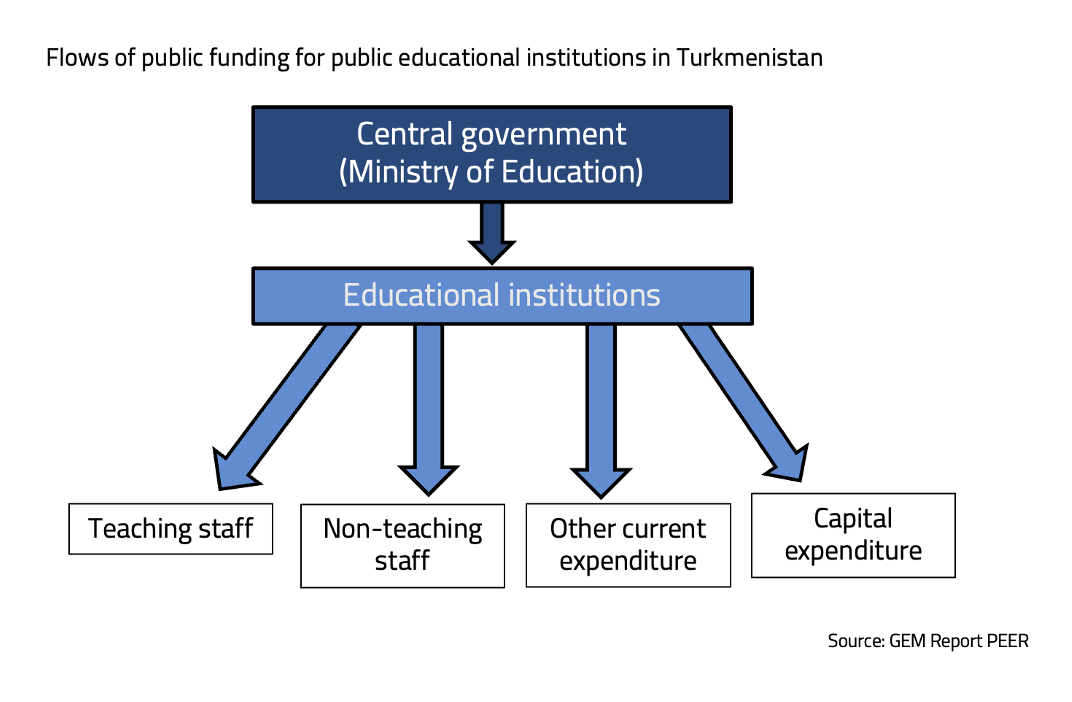
In Turkmenistan, education financing and governance are highly centralised, with basic education funded by the State Budget under the Law on Education. The Ministry of Education directly finances institutions implementing the national curriculum, while schools offering specialised programmes may also charge tuition fees as a supplementary source of funding. Funding for state institutions is based on per-student standards, adjusted for curriculum complexity, teaching methods, student disabilities, and safety requirements, with additional support for small and rural schools. Non-state institutions must meet or exceed the minimum funding standards of public schools and may provide scholarships using their own or external resources. Educational institutions can also utilise extra-budgetary funds to support students in need and manage their financial and economic activities independently.
1. Education resources to subnational governments
Due to the centralised structure of the education financing system, no mechanism exists to transfer funds from the central government to local authorities with built-in equity considerations.
2. Education resources to schools
Centralised Funding Scheme
The Law on Education, adopted in 2021, establishes a centralised funding scheme for public educational institutions, based on per-student standards that account for institution type, programme content, teaching methods, forms of instruction, and the needs of students with disabilities. In addition to these differentiated norms, the law provides for the financing of measures aimed at ensuring safe learning environments and supporting student well-being within schools. Importantly, it introduces adjustments for small and rural institutions, particularly those located in geographically remote areas or with limited transport accessibility. In such cases, funding norms may be increased to ensure that essential fixed costs, including basic staffing, school operations, and transport-related needs, are covered regardless of enrolment size. This provision acknowledges that strictly applying per capita formulas would underfund small or isolated schools and helps maintain access to education in sparsely populated or hard to reach areas.
3. Education resources to students and families
No initiatives were identified for transferring funds from the Ministry of Education to disadvantaged students or households.
4. Social policies and family support programmes
No initiatives were identified for transferring funds from government ministries to disadvantaged students or households.
5. School meal programmes
Turkmenistan does not have a formal, nationwide school meal programme providing full meals to students on either a universal or targeted basis. However, the National Nutrition Programme 2020–2025, developed with support from UNICEF and WHO, demonstrates the government’s commitment to improving population nutrition, including that of children, through multi-sectoral coordination across health, education, social protection, agriculture, and food security. While the programme focuses on nutrition awareness, adequate nutrition for pregnant women and children, and the prevention of obesity and diet-related non-communicable diseases, it does not include a structured school feeding component.










