


Financing for equity in primary and secondary education
1. Education resources to subnational governments
2. Education resources to schools
3. Education resources to students and families
4. Social policies and family support programmes
Introduction
In Namibia, the Ministry of Education, Innovation, Youth, Sports, Arts and Culture (MoEIYSAC) oversees education provision and funding, following the 2025 merger of the Ministry of Education, Arts and Culture (MoEAC) and the Ministry of Higher Education, Technology and Innovation (MoHETI).
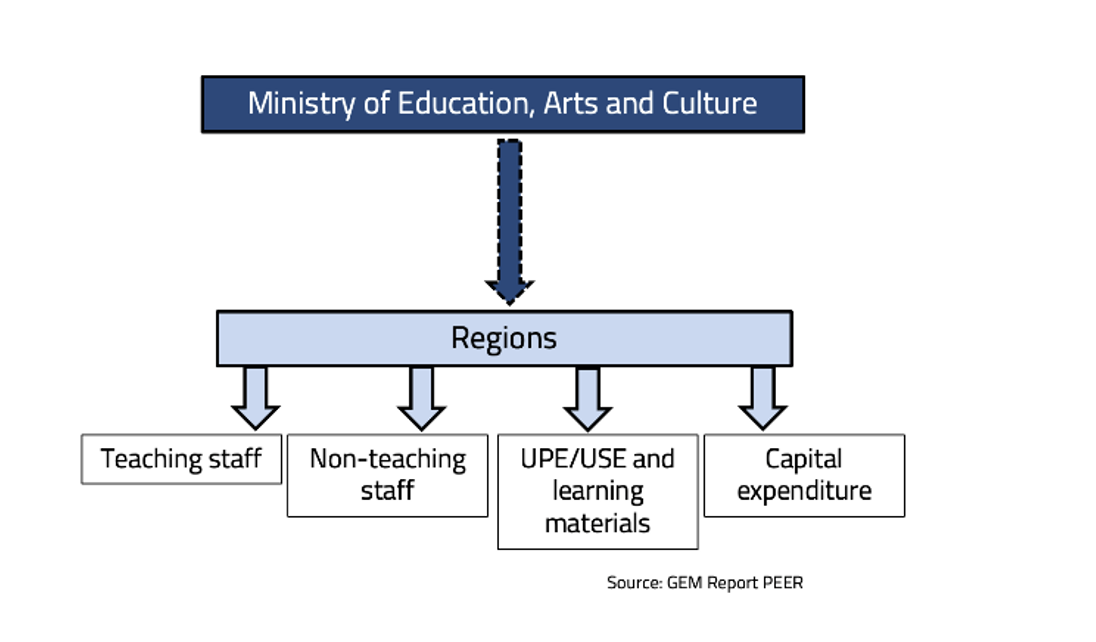
Funding is decentralised: the central government allocates resources to the 14 regions for personnel, operational, and capital expenditures, and regional authorities manage schools within their jurisdictions. Local authorities and schools do not have independent financial authority, implementing budgets according to the central Ministry guidelines.
1. Education resources to subnational governments
Regions receive funding from the MoEAC based on student enrolment numbers, which they then use to allocate resources to individual schools. The current funding model does not adjust for regional or income disparities.
Two separate datasets are used to calculate allocations at the national and regional levels, both based on enrolment numbers. Due to enrolment growth, the actual funding per learner at the regional level is often lower than the amounts projected at the national level.
2. Education resources to schools
Universal Primary and Secondary Education Grants
Regional allocations to schools include grants for Universal Primary Education (UPE), introduced in 2013, and Universal Secondary Education (USE), introduced in 2016. Allocations under these programmes follow an equalisation funding model, with each learner receiving N$300 at the primary level and N$400 at the secondary level for the 2024/25 academic year. This model does not account for regional or income disparities.
Students with disabilities in resource schools or special classes receive fivefold the mainstream allocation—N$1,500 for primary and N$2,000 for secondary—reflecting the higher costs of learning materials.
Under the 2021–2030 School Grant Policy, the MoEAC has updated the school funding system to a needs-based formula running from 2025 to 2029. Allocations will consider school location, poverty levels, and access challenges, aiming to reduce national educational disparities, improve rural school services, and ensure equitable access to teaching materials. This includes funding for disability-friendly infrastructure and assistive technologies for learners with disabilities.
Remote Teacher Allowances
The government provides special allowances for teachers in remote locations. Schools are categorised into four remoteness levels, from Category 1 (most remote) to Category 4 (least remote). More remote schools are concentrated in largely rural regions such as Kunene and Oshikoto, while nearly all schools in Khomas and most in Erongo fall into Category 4.
3. Education resources to students and families
Namibia does not offer scholarship or bursary schemes for students at the primary or secondary levels. Financial assistance at the higher education level is provided through the Namibia Students Financial Assistance Fund, which supports students enrolled in universities and TVET institutions. Eligibility and allocations are determined based on regional quotas and parental income, ensuring that support is directed to students with demonstrated financial need.
4. Social policies and family support programmes
Marginalised Communities Education Support Programme
The Marginalised Communities Education Support Programme, managed by the Division of Marginalised Communities within the Ministry of Gender Equality, Poverty Eradication, and Social Welfare, provides financial and transport assistance to indigenous students from the San, Ovatue, and Ovatjimba communities across all education levels. For primary and secondary students, support includes transportation to boarding schools, while tertiary students receive assistance for tuition fees, accommodation, and a monthly allowance. The programme was launched in 2005 for tertiary students and expanded to include primary and secondary students in 2018.
5. School meal programmes
Namibian School Feeding Programme
The Namibian School Feeding Programme, initially managed by the World Food Programme since 1991, has been fully administered by the Ministry of Education, Arts and Culture (MoEAC) since 1996. The programme provides one nutritious meal per day to students in public primary schools, with meal composition guided by national food and nutrition guidelines and designed in consultation with nutritionists familiar with local dietary habits and conditions.
Geographical targeting determines which schools benefit from the programme, using data from national vulnerability assessments, food and nutrition surveys, and poverty studies such as the Namibian Household Income and Expenditure Surveys (NHIES). Criteria include gender-specific enrolment, attendance, drop-out, and promotion rates; household food security; distance of schools from learners’ homes; and regional or household socio-economic and nutritional indicators. Priority is given to rural schools and, on a case-by-case basis, peri-urban schools that meet minimum implementation requirements, including hygiene, water and sanitation, kitchen and storage facilities, and community commitment.
The long-term goal of MoEAC is to establish a universal school feeding programme providing nutritious meals to all Namibian children, with plans to expand coverage to secondary schools and early childhood development centres.
This profile has been reviewed by Prof. Gilbert Likando, University of Namibia.










