
Financing for equity in primary and secondary education
1. Education resources to subnational governments
2. Education resources to schools
3. Education resources to students and families
4. Social policies and family support programmes
Introduction
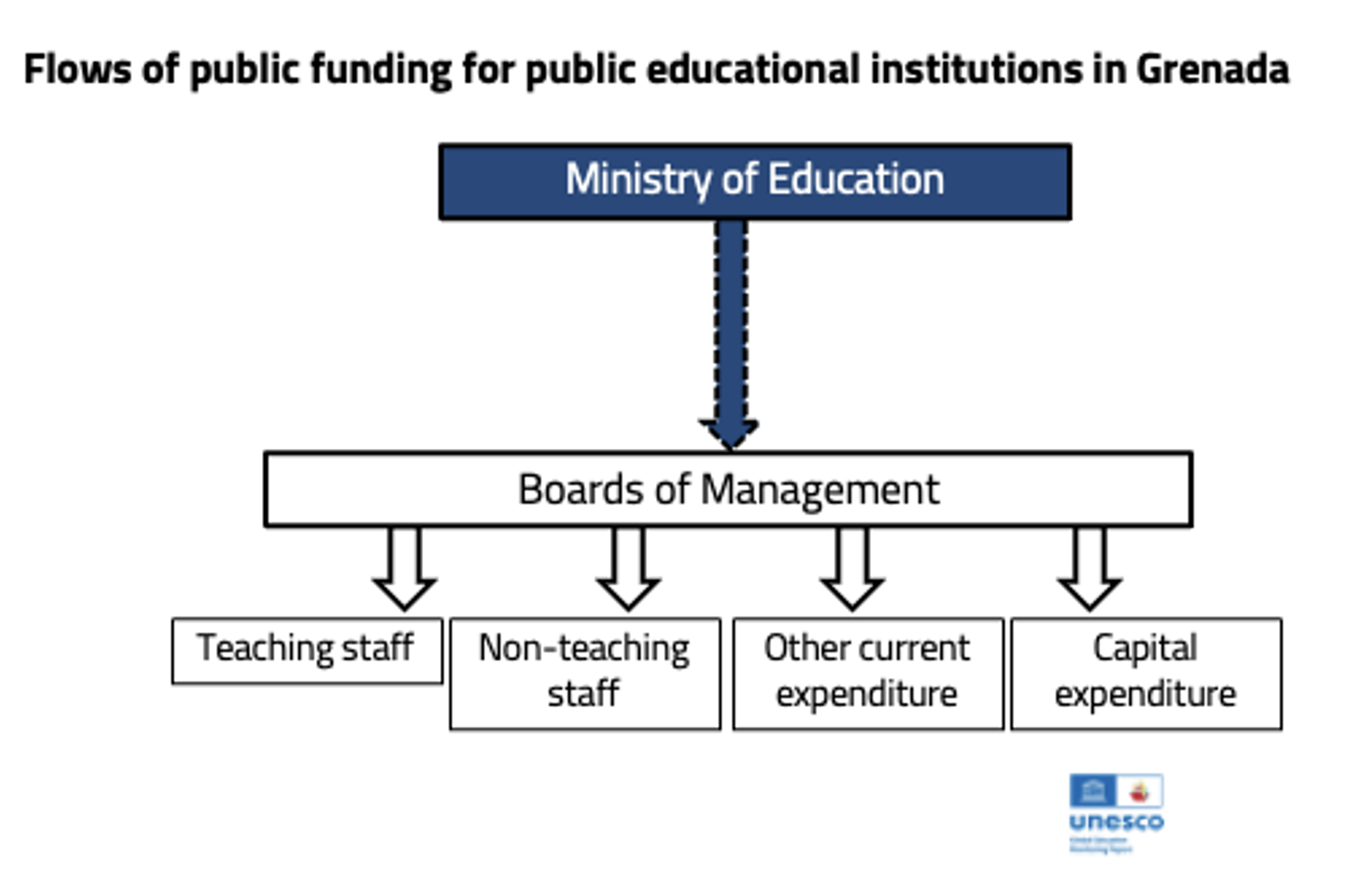
In Grenada, school financing is primarily determined at the central level by the Ministry of Education, which allocates funds to schools in the form of grants provided to the Boards of Management. For secondary schools, financial resources are approved by Parliament, either through specific votes for individual institutions or as part of a broader allocation for secondary education. In addition to government funding, schools may also generate financial resources through fundraising activities, gifts, bequests, trusts, donations, or other sources.
1. Education resources to subnational governments
Resources are managed and distributed at the central level.
2. Education resources to schools
Resources are allocated to schools by the Ministry of Education to finance all expenditures of public schools. Programmes aimed at promoting equity are primarily funded through loans and grants from external donors, such as the Global Partnership for Education, which supports the Grenada Education Enhancement Project (CDB) and UNESCO, which supports the Child Friendly Schools initiative. The allocated resources are entrusted to the Board of Management, which is responsible for their receipt, disbursement, and accounting. Each school’s operation and maintenance budget is prepared by the principal and reviewed by the Board of Management for approval. Financial statements for all school finances must be submitted to the Chief Education Officer within seven days after the end of each term.
State-owned public schools are fully owned, managed, and financed by the government. Assisted private schools are privately owned, often by religious denominations, but receive substantial government support. Private schools are established, managed, and financed by private individuals or entities without government assistance. Denominational schools, established and managed by religious denominations, may function as either private or public institutions depending on their source of financing.
Special Education
Special Education is overseen by the Chief Education Officer, who must provide a special education programme for any student of compulsory school age, or for any dependent child beyond that age, who requires specialised education due to intellectual, communicative, behavioural, physical, or multiple exceptionalities. Education is delivered in the least restrictive and most enabling environment that available resources permit. Students may receive support either through an individual education plan tailored to their specific needs or through special education schools.
The Ministry of Education finances its special education initiatives through infrastructure investments, personnel salaries, and other resources. It also receives support from the Organisation of Eastern Caribbean States (OECS), which implements regional projects such as the OECS PEARL for Special Education, aligned with the OECS Education Sector Strategy (OESS). These initiatives aim to enhance access to education and improve learning outcomes in basic education.
Grenada's special education framework, as currently mandated, has been in place since 2002 with the enactment of the Education Act No. 21 of 2002 (Chapter 86), which established the Chief Education Officer's legal duty to provide special education programmes for students with exceptionalities in the least restrictive environment, either via individual education plans or special schools.
3. Education resources to students and families
School Supplies and Uniform Assistance Programme
The School Uniform Assistance Programme was launched in 1997 by the Government, with international support, particularly from Taiwan. Over time, the programme has been regularly organised and modernised by the Ministry of Education, including the introduction of electronic and QR code–based systems to improve delivery efficiency. The programme’s scope has expanded to cover both school uniforms and additional school supplies, providing support to parents to ensure that school-aged children have the necessary resources to attend school. Assistance is provided in the form of digital vouchers, which can be redeemed at authorised vendors for items such as uniforms, shoes, school bags, lunch kits, stationery, and mathematical tools.
4. Social policies and family support programmes
Support for Education, Empowerment and Development (SEED)
The Support for Education, Empowerment and Development (SEED) programme, initiated in 2013, aims to promote school enrolment and attendance while providing poverty alleviation through cash-based support for school and health care. The programme targets low-income students and children, individuals with disabilities, the elderly, and those experiencing indigence.
To receive assistance, children aged 5 to 8 years must meet school attendance requirements in public schools. Household members aged 0 to 5 years are required to attend health clinic visits, and parents must be registered with public health facilities. Additionally, parents and young adults are expected to participate in Developmental Awareness Sessions, which include workshops on health care, nutrition, reproductive health, and related topics.
In 2024, the SEED programme was reformed to provide up to a 66% increase in benefits to the most vulnerable populations.
5. School meal programmes
National School Feeding Programme
The School Feeding Programme has been in operation since 1950, initially providing milk and cookies to children in primary schools. Over time, it has expanded with support from the government, international funding agencies, and local non-governmental organisations. The programme now provides hot meals not only in primary schools but also in preschools, including some daycare centres, and in select secondary schools.
Currently, the programme covers all primary schools, preschools attached to primary schools, some independent preschools, and fourteen of the twenty-two secondary schools. Meals are typically prepared on school premises. The programme aims to ensure that children from socio-economically disadvantaged backgrounds receive nutritionally adequate meals, to promote awareness of the nutritional value of local foods, and to improve school enrolment and regular attendance, thereby reducing dropout and repetition rates.
Schools generally follow a four-week cycle menu, with flexibility to adjust for seasonal availability, although some schools prepare weekly menus. No information is available regarding adherence to national nutritional guidelines. Nutrition is integrated into Health and Family Life Education and is also taught separately through home economics at the primary and secondary levels.
This profile was reviewed by Oliver Benoit, PhD, MFA, and Professor of Sociology in the Department of Humanities and Social Sciences from the School of Arts and Sciences at St. George's University.